
Articles and Adhocs
Designing Forensic Psychology Article - 8th June 2026
I’m particularly pleased to share that my latest article has now been published on Open Learn
The piece explores my PhD research through design into parenting education and support for mothers who are justice experienced, and the potential of service design with co-design, to create more responsive, empowering and sustainable systemic support.
This is an area where design, psychology and social justice intersect, with important implications for children, families and services.
If you are interested, it’s a 5-minute read:
And if you'd like to get your voice heard with study 3 interviews, please get in contact:
rachel.wood@open.ac.uk

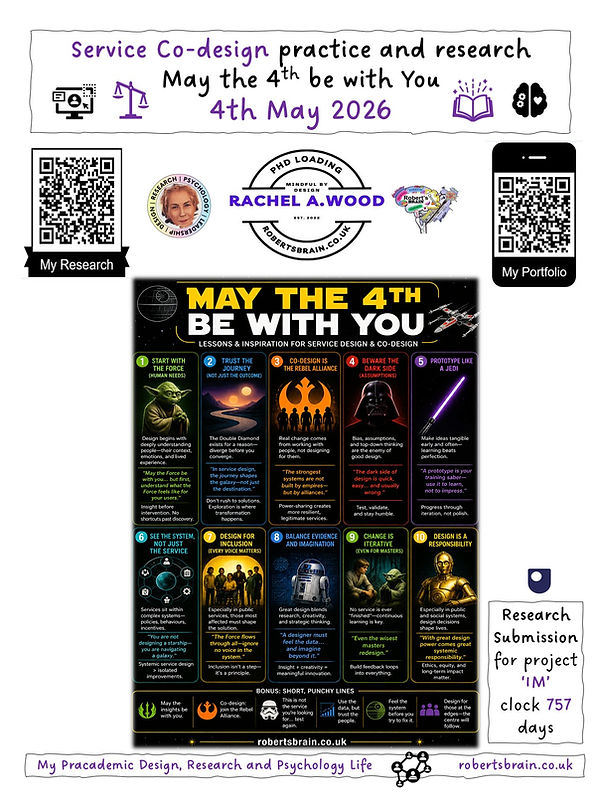

You can read the full World Book Day Blog here:
World Book Day 2026: What Regeneration Teaches Us About Trauma-Informed Design

The Psychologist - 6th February 2026


Article Contribution
Living Etc. (Digital) published 18th August 2025
Read the article here: What is ‘Design Fixation’? And Can It Be Avoided? | Livingetc
Includes - eight steps for avoiding fixation
"Design fixation is a well-documented cognitive bias where a designer becomes stuck on a limited set of ideas, often influenced by prior knowledge, previous solutions, or dominant trends," explains design psychology expert Rachel A. Wood.
"Psychologists trace its roots to the 'Einstellung effect', a term first coined in the 1940s when researchers discovered that people tend to solve problems using familiar solutions, even when better alternatives exist," continues Rachel.

'Emotional engagement is an essential part of the design process'
Article for the Psychologist - Print Copy (Sept 2025)
by Rachel A.Wood and Samantha Osys
Read the article here:

A


'Emotional engagement is an essential part of the design process'
Article for the Psychologist - 22nd January 2025
by Rachel A.Wood and Samantha Osys
Read the article here:
https://www.bps.org.uk/psychologist/emotional-engagement-essential-part-design-process



Building an inclusive workplace with support from our colleagues
by Rachel A.Wood 26th November 2024
Original article source: https://www.maximusuk.co.uk/article/building-an-inclusive-workplace-with-support-from-our-colleagues

Our commitment to creating an inclusive workplace where individuals with disabilities and health conditions can thrive remains at the heart of everything we do. Through our colleague-led networks we’re proud to amplify the voices of every colleague, driving meaningful change at every level of the business.
As we celebrate UK Disability History Month, MaxAbility board member and Head of Customer Journey, Rachel Wood, shares more about her acquired disability and her passion for supporting those with disabilities in the workplace.
My career
With over 35 years’ experience in public services, I first discovered my passion for service design early in my career, and it has since become a lifelong commitment. In 2014, I took on a dedicated role in service design leadership, where I’ve had the privilege of being involved in over sixty designs and redesigns.
I joined Maximus in September 2024 as Head of Customer Journey in Citizen Services. In my role, I am a custodian for customer journeys, overseeing the roadmap that outlines how we aim to achieve our goals in practical steps. This involves innovating and ‘future-proofing’ our services, while ensuring we meet the diverse needs of those we serve.
I am deeply focused on customer experience excellence and service satisfaction. I feel most fulfilled when I can innovate and create effective pathways for service users.
Life with Hodgkin’s Lymphoma
My life took a dramatic turn in my mid-forties when I was diagnosed with Hodgkin’s Lymphoma after six months of feeling unwell. I had never heard of this rare blood cancer, which affects around 1,600 people in the UK each year. After being diagnosed for a second time in 2017, I underwent a stem cell transplant. The intensive treatment, which included chemotherapy and nuclear medicine, led to several complications including sepsis, pneumonia, and osteoporosis.
Living with Hodgkin’s Lymphoma has made me a “Hodgkin’s Lymphoma ‘aliver.’” I now focus on adapting my life positively and learning to cope with the challenges that come with my acquired disability.
My mobility has significantly reduced, and I am now reliant on using a stick to prevent falls. Activities I once enjoyed, like walking, now feel monumental – ten minutes of slow walking can leave me feeling like I’ve completed a marathon.
Despite these challenges, I embrace technology to help me manage everyday tasks. Working from home has been particularly beneficial, allowing me to lead a meaningful life while contributing positively to society. My focus is on what I can do, not what I can’t.
Disability support in the workplace
Over the past 10 to 15 years, I have seen a positive shift in how workplaces support individuals with disabilities. While approaches may vary across sectors, there is a growing recognition of the importance of having a diverse workforce for innovation and effective decision-making. Organisations that mirror the demographics of their customers are better equipped to meet their needs.
There are still misconceptions about disabilities that need to be addressed. Not all disabilities are visible. In my case, I experience both hidden (immunity) and visible (mobility) challenges. I wear a medical bracelet and a lanyard during my rare outings to help communicate my needs, as sometimes it’s easier than trying to explain them myself.
As we mark UK Disability History Month, the theme of Disability, Livelihood, and Employment resonates deeply with me. For me, it’s about supporting everyone to fulfil their potential, and it’s crucial that we focus on what enables individuals to overcome challenges rather than what hinders them.
We all need to think more creatively about inclusion in the workplace, and use every opportunity to experience it through those who find them the most challenging. If we make things more accessible, both physically and digitally, we will be helping everyone, not just those who we think need it most.
Looking to the future
I am hopeful for a world that embraces our differences and celebrates our shared humanity. I believe in focusing on the good that unites us in making services equitable for everyone.
In my first two months at Maximus, I have been blown away by the sense of belonging I’ve felt by being part of a network like MaxAbility. I’m committed to supporting this vital work, drawing on my own lived experience with acquired disability.
I aim to be a strong ally to my colleagues and customers; I’m excited to contribute to a future where inclusivity is the norm, and everyone has the support they need to thrive
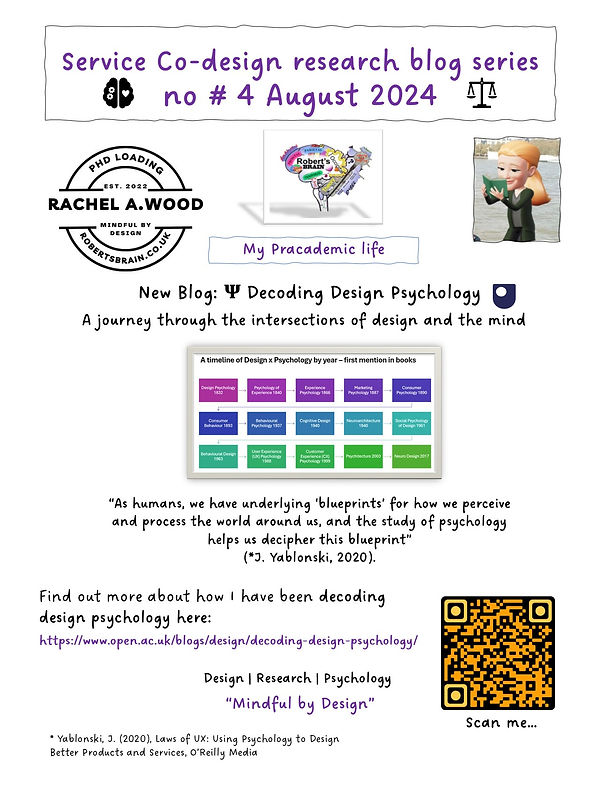


Happy focus Friday (15th September 2023). Today has been a dedicated research day, with a very productive virtual writing retreat for a co-authored article. Todays reflection has also very much been on what can make for a successful implementation in goal setting and Objectives and Key Results (OKRs) in design leadership
In ‘OKRs for all: making objectives and key results for your entire organisation’ Vetri Vellore (2022) proposes that using them can:
-
Shift focus to impact
-
Creates co-operation and collaboration
-
Helps navigating rapid change and reduces risk
-
Create clarity and inspires stretch
-
Supports contextual communication and continuous progress
The reading undertaken so far has found the evidence base is very much founded on theories of human motivation such as:
🎯Goal setting – tthrough 50 years of research (such as in Locke and Latham, 1990, 2013, 2019). Argues for the importance of goal clarity, setting stretch targets that are achievable, working forward and receiving regular feedback. For my practice I have noted the importance of process evaluation (feedback loop) , and setting regular opportunities for checking in on progress
🎉Self efficacy – behavioural change and wellbeing (such as Bandura, 1977). Looks at beliefs in personal capacity, the importance of social persuasion and context. In my practice this shows the need for observation, and supporting and celebrating the success of others
🤯Self determination – psychological needs related to autonomy, competence and relatedness (such as Deci and Ryan, 1980, 2008, 2017). In my practice I have noted how this is related to the intersection of purpose, strategy and execution 🚀
In addition OKRs have also been linked to the ‘test and learn’ agenda (such as Plan, Do, Study/Check, Act cycles introduced by Shewhart in the 1920s and later by Deming 1959). As such in ‘Design thinking, and innovation metrics’ (2023) Michael Lewrick proposes that developing them also supports: decision making, problem solving and sustainable continuous improvement
So so far they seem to be an imperative in terms of practice – that is very well founded in the current knowledge and evidence base
If you have an interest in implementing OKRs, it would help me to understand this further by giving a moment of your time to answer the following question:
As a design leader - what has worked for you in implementing goal setting and Objectives and Key Results (OKRs)? https://app.sli.do/event/7EsHfVJ7qLeBbyurX9Noev (closes 22nd September 2023)
The findings, and a discussion will be published in future week-notes…
If you are interested in some of the conundrums in continuous improvement my peer PhD Researcher has written a thought-provoking blog on this topic:
Looking forward to your thoughts and contributions. In the meantime, many thanks for your time - have a great rest of your design day 😊
